
 By Rejish Shrestha
Table of Contents

SEO, or Search Engine Optimization, is the practice of improving a website so that search engines rank it higher and people can find it without paid advertising. It matters because organic traffic, the kind that comes from unpaid search results, is free, compounds over time, and reaches people who are actively looking for what you offer.
Whether you run a business, a blog, or a service website, SEO determines whether your audience finds you or your competitor. This guide explains what SEO is, how search engines process your site, what SEO involves in practice, and why it is worth investing in.
What is SEO?
SEO is not a single action. It is an ongoing process that combines content, technical improvements, and authority-building to improve how a website performs in search results.
i. SEO Definition
SEO stands for Search Engine Optimization. It is the process of improving a website’s content, structure, and authority so that search engines can understand it and connect it with the right audience at the right time. The goal is to appear in organic search results, meaning results that are not paid for, when someone searches for a topic relevant to your site.
Understanding the difference between related terms helps clarify where SEO fits in the broader marketing picture.
| Term | What It Means |
| SEO | Improving a website to rank higher in unpaid search results |
| SEM | Search Engine Marketing; includes both SEO and paid search advertising |
| SEA | Search Engine Advertising; paying for ads to appear in search results |
| PPC | Pay-Per-Click; the pricing model used in SEA where you pay each time someone clicks your ad |
ii. Organic vs Paid Search
Organic traffic comes from unpaid rankings. When your page appears in search results because Google considers it relevant, that click costs you nothing. Paid search, by contrast, requires a budget. You pay each time a user clicks your ad, and traffic stops the moment the budget runs out. SEO builds an asset that keeps delivering traffic without ongoing spend. Both approaches have their place, but SEO provides long-term, sustainable visibility that paid advertising alone cannot replicate.
iii. A Brief History of SEO
SEO began in the mid-1990s when websites first started optimizing for search engines. Early algorithms relied heavily on keyword density, how many times a keyword appeared on a page, to determine relevance. Website owners quickly exploited this by stuffing pages with repeated keywords regardless of quality. Search engines recognized the problem and began developing smarter algorithms that prioritized content quality, user experience, and authority signals such as backlinks. Google has released major algorithm updates continuously since then, each moving further away from easy manipulation and closer to rewarding genuinely useful content. Understanding this history explains why modern SEO focuses on quality, trust, and user experience rather than technical tricks.
How Search Engines Work
To understand why SEO decisions matter, you first need to understand how search engines work, including how they crawl, index, and rank content across the web before a user ever types a query.
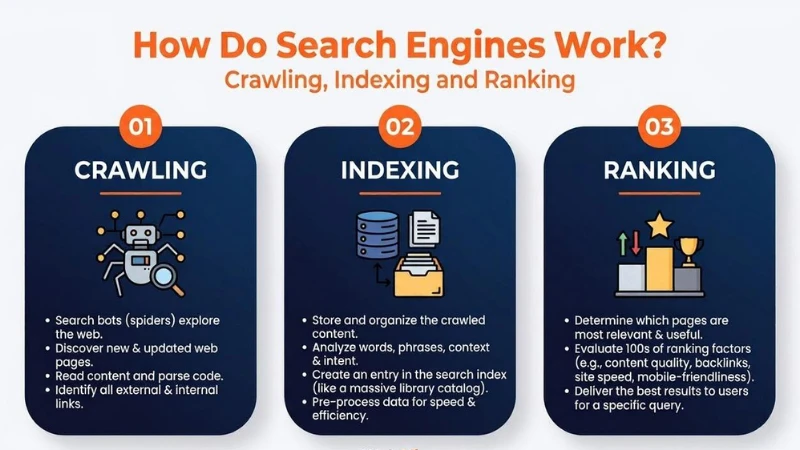
i. Crawling
Search engines use automated programs called crawlers or spiders to discover content on the web. These crawlers visit pages and follow links from those pages to find new ones. If a page has no links pointing to it and is not submitted directly to a search engine, crawlers may never find it. This is why internal linking and backlinks play a role in SEO beyond just authority.
ii. Indexing
Once a page is crawled, the information on it is processed and stored in a search index. The index is a digital library containing data about billions of web pages. It is constantly updated as new pages are discovered and existing pages are changed. A page that is not indexed cannot appear in search results, regardless of how well-optimized it is.
iii. Ranking
When a user types a search query, the search engine looks through its index and uses a complex ranking algorithm to determine which pages are most relevant and useful. It then displays those pages in order on a search engine results page (SERP). The algorithm evaluates hundreds of factors to make this decision.
| Phase | What Happens | What It Means for Your Site |
| Crawling | Bots discover and download your pages | Your pages must be accessible and linked |
| Indexing | Page content is stored in the search database | Your content must be clear and indexable |
| Ranking | Algorithm orders results by relevance and quality | Your content must match what searchers need |
iv. How Google Personalizes Results
Search results are not identical for every user. Google adjusts rankings based on a user’s location, language, and past search history. This means a search for “best digital marketing agency” produces different results in Kathmandu than in New York. For businesses in Nepal, this personalization is a direct opportunity. Optimizing for local search signals ensures your site appears for the audience that can actually use your services.
The Three Pillars of SEO
SEO activity falls into three interconnected areas. Each addresses a different dimension of how search engines evaluate a site, and weakness in any one of them limits overall performance.
i. On-Page SEO
On-page SEO covers everything on your website that you can directly control to improve relevance and quality. This includes content optimization, title tags, meta descriptions, header structure, internal linking, URL format, and image alt text. It also includes demonstrating E-E-A-T signals, which Google uses to assess the credibility and trustworthiness of a page and its author.
| E-E-A-T Signal | What It Means | How to Demonstrate It |
| Experience | First-hand experience with the subject | Share personal case studies, original data, or direct observations |
| Expertise | Knowledge and qualifications in the field | Author credentials, accurate and detailed content |
| Authoritativeness | Reputation as a reliable source on the topic | Backlinks from respected sites, brand mentions, citations |
| Trustworthiness | Transparency and accuracy of the site | Accurate information, clear authorship, HTTPS, privacy policy |
E-E-A-T is especially important for topics that affect health, money, safety, or major decisions. Google applies stricter quality assessment to these areas.
ii. Technical SEO
Technical SEO addresses the infrastructure of your website. It ensures that search engines can access, crawl, and understand your pages without obstacles. Key technical factors include page load speed, mobile-friendliness, HTTPS security, XML sitemaps, canonical tags to prevent duplicate content issues, and structured data markup that helps search engines understand what type of content a page contains. Google uses the mobile version of your site for indexing and ranking. A site that performs poorly on mobile devices is at a direct ranking disadvantage regardless of content quality.
iii. Off-Page SEO
Off-page SEO covers actions taken outside your website that build its authority and reputation. Backlinks are the most important off-page signal. A backlink is a link from another website to yours. Search engines treat backlinks as votes of confidence. Pages with more high-quality backlinks tend to rank higher because other credible sites are endorsing their content. Quality matters more than quantity. A single link from a relevant, authoritative website carries more weight than dozens of links from low-quality or unrelated sites.
| Link Building Method | What It Involves |
| Guest Blogging | Write content for another site and earn a link back to yours |
| Broken Link Building | Find dead links on other sites and suggest your content as a replacement |
| Original Research | Publish studies or data that others cite and link to |
| Local Citations | List your business in relevant directories with consistent name, address, and phone number |
| Google Business Profile | Optimize your business listing to appear in local map results |
Off-page SEO also includes brand mentions, social media presence, and for local businesses, maintaining consistent business information across all online directories.
How SEO Works in Practice
Understanding the three pillars tells you what SEO involves. Applying it requires four specific disciplines that drive day-to-day SEO work.
i. Keyword Research
Keyword research identifies the exact terms and phrases your target audience types into search engines. Effective keyword research looks at search volume (how many people search for a term), keyword difficulty (how hard it is to rank for it), and search intent (what the searcher actually wants). The best keywords combine reasonable traffic potential with direct relevance to your business. Tools used for this include Google Keyword Planner, Ahrefs, SEMrush, and Ubersuggest.
ii. Search Intent
Search intent is the underlying reason behind a query. Google evaluates whether your content matches what the searcher actually wants, not just whether it contains the right keywords. Getting intent wrong means your page will not rank even if it is well-written. There are four types of search intent:
| Intent Type | Example Query | Best Content Format |
| Informational | “what is SEO” | Blog post, guide, explainer |
| Navigational | “Ahrefs login” | Brand page, direct URL |
| Commercial | “best SEO tools 2026” | Comparison article, review |
| Transactional | “buy SEO audit service” | Service page, product page |
Analyzing the top-ranking pages for any keyword shows you what content type and format Google considers the best match for that query.
iii. Content Quality
Google ranks pages, not websites. Each page is evaluated individually for quality. High-quality content is helpful and directly answers the search query, well-structured with logical headings and clear paragraphs, accurate and current, and unique in that it offers something the competing pages do not. On-page elements such as title tags, image alt text, and schema markup help Google understand the content and context of each page. Freshness also matters for queries where up-to-date information is expected, such as news, pricing, or evolving topics.
iv. User Experience
Google measures how users interact with pages as a signal of quality. The page experience signals it publicly confirms include Core Web Vitals scores covering loading performance, interactivity, and visual stability, mobile-friendliness, HTTPS security, and the absence of intrusive popups that block content. Research from Adobe indicates that nearly 8 in 10 consumers stop engaging with content that does not display correctly on their device. A site that is fast, secure, and mobile-friendly meets the baseline Google expects before other ranking factors come into play.
Why SEO Matters for Your Website
SEO is not just a technical exercise. It directly affects whether your business grows online or remains invisible to the people looking for it.
i. Free and Sustainable Traffic
Every click from organic search costs nothing. Unlike paid advertising where traffic stops when spending stops, SEO builds a compounding asset. A well-optimized page can continue generating traffic for months or years after it is published, with only periodic updates required to maintain performance. For businesses in Nepal looking to grow online presence without large advertising budgets, this is a significant advantage.
ii. Intent-Driven Audience
People who find your site through search are already looking for what you offer. This is fundamentally different from social media advertising, where ads interrupt users who have no expressed interest in your product. Because search traffic is intent-driven, it converts at higher rates. If you offer SEO services Nepal, appearing in search results for relevant queries puts you in front of potential clients at the exact moment they are looking for those services.
iii. Competitive Advantage
Every industry has competitors with websites. The businesses that invest in SEO capture the organic search audience. Those that do not lose that traffic to whoever ranks above them. Higher search visibility increases brand recognition, generates more touchpoints with your audience, and builds authority over time. A competitor who has been doing SEO for two years already has an advantage in rankings, backlinks, and topical authority that takes sustained effort to close.
iv. Local SEO for Nepal-Based Businesses
For businesses operating in Nepal, local SEO determines visibility in location-based searches. When someone searches for a service in Kathmandu or a specific city, Google uses local signals to decide which businesses to show. Key local SEO factors include a complete and accurate Google Business Profile, consistent business name, address, and phone number across all online directories, local keyword optimization, and customer reviews. Appearing in Google’s map pack, the section showing a map and three business listings, often generates more clicks than standard organic results for local queries.
v. SEO in 2026: AI and Changing Search Behavior
AI Overviews now appear at the top of many Google search results, pulling information from multiple sources to answer queries directly on the results page. This reduces clicks for some queries but increases the value of being the site Google cites as a source. Zero-click searches, where users get their answer without visiting any site, are growing in volume. The correct response is not to treat SEO as less important, but to shift focus toward building topical authority, brand recognition, and visibility across multiple platforms. Being the most credible and comprehensive source on a topic increases the chance of appearing in AI-generated answers.
Setting SEO Goals
Modern SEO measurement goes beyond checking where a page ranks for a single keyword.
i. What to Track
Effective SEO measurement tracks organic traffic volume and trends, engagement metrics such as time on page and pages per session, conversion rate from organic traffic, brand search volume as an indicator of growing awareness, and user satisfaction signals. Google Search Console provides search performance data directly from Google and is the starting point for any SEO measurement setup. If you are looking to build the skills to manage this yourself, this guide on how to become an SEO expert covers the full roadmap from beginner to expert level.
ii. SEO Ranking Factors to Prioritize
The exact formula Google uses to rank pages is not public, but Google has confirmed a number of ranking signals and the broader SEO community has extensive evidence of others. Focusing on these factors covers the foundation of strong SEO performance.
| Ranking Factor | Why It Matters |
| Content quality and relevance | Google ranks pages that best answer the search query |
| Backlinks | Links from authoritative sites signal trust and authority |
| Search intent match | Content must align with what the searcher actually wants |
| Page experience (Core Web Vitals) | Slow or unstable pages rank lower regardless of content quality |
| Mobile-friendliness | Google uses the mobile version of your site for indexing |
| HTTPS security | Google confirmed HTTPS as a ranking signal |
| Content freshness | Time-sensitive queries reward recently updated content |
Conclusion
SEO is the foundation of long-term online visibility. It brings in an audience that is already looking for what you offer, builds authority that compounds over time, and delivers traffic without ongoing advertising costs. Understanding what SEO is and why it matters is the first step. Applying it consistently across content, technical setup, and authority-building is what produces results.
FAQ
What does SEO stand for?
SEO stands for Search Engine Optimization. It is the practice of improving a website so search engines rank it higher in organic, unpaid search results.
What is the difference between SEO, SEM, and PPC?
SEM stands for Search Engine Marketing and covers all efforts to appear in search results, both through organic SEO and paid advertising. SEO is the organic component of SEM. PPC stands for Pay-Per-Click and is the pricing model used in paid search advertising, where the advertiser pays a fee each time a user clicks an ad.
What are the main types of SEO?
The three main types are on-page SEO, which covers content and page-level optimization; technical SEO, which covers site infrastructure and crawlability; and off-page SEO, which covers backlinks and authority-building. Subtypes include local SEO for location-based businesses, ecommerce SEO for online stores, and video SEO for video content platforms.
How long does SEO take to show results?
SEO typically takes between three and six months to show measurable results, based on a study of over 4,000 respondents by Ahrefs. The timeline varies depending on the competitiveness of the keywords, the age and authority of the site, the quality of the content, and how consistently SEO work is applied.
Can I do SEO on my own?
Yes, for small to medium-sized websites. The fundamentals of SEO are learnable and many tools offer free tiers that cover keyword research, technical audits, and performance tracking. Larger websites with more complex structures may require a dedicated specialist or agency. If you want professional guidance, working with a recognized SEO expert Nepal can accelerate results.
Is SEO still relevant in 2026?
Yes. Organic search remains one of the primary ways people discover information, products, and services online. AI-generated search features have changed how some results are displayed, but they rely on the same well-optimized, authoritative content that SEO produces. The fundamentals of SEO, quality content, technical soundness, and earned authority, continue to determine what gets cited, ranked, and recommended.